

Improve credit restraint mechanism, strengthen enterprise dishonesty governance
For the outstanding lack of credibility, we should not only promptly create a credit reference system covering the whole society, but also improve a law-abiding credit commendation mechanism and a law-violating dishonesty punishment mechanism, so that people dare not and cannot lose their credit.
Credit environment has a long-term positive impact on the economic growth, which has become the cornerstone of modern economy, affecting the credit sales and purchases between enterprises, the issuance and trading of financial products, as well as the expectations of investors. Good credit plays an important role in strengthening the corporate governance structure, attracting foreign investment and forming comparative advantage through export. Fundamentally speaking, the construction of credit system has become an important component of creating a good business environment.
Therefore, since the 18th National Congress of the Communist Party of China, the Central Committee has put forward the significant goal of accelerating the construction of social credit system and building an honest and trustworthy economic and social environment from the overall strategic level. It has successively proposed “strengthening the construction of government integrity, business integrity, social integrity and judicial public credit” and “building and improving the social credit system, praising honesty and punishing dishonesty”. The State Council issued and implemented the Planning Outline for the Construction of Social Credit System (2014-2020).
Economic activities cannot be separated from the construction of credit system
(1) Trust, trade and market expansion
Adam Smith, a classical British economist, put forward the view that the division of labor promoted the labor productivity in the Wealth of Nations. Through the division of labor, the market economy can develop continuously, which finally determines that the market mechanism plays decisive role in the allocation of resources. However, the development of division of labor must rely on the mutual trust between people. Adam Smith pointed in the Theory of Moral Sentiments that economic activities are built on social habits and moral basis, and the trading activities of people will be seriously affected without these habits and morality and the foundation of trade will be shaken. The moral basis mentioned here mainly refers to the trust between people.
Along with the development of economic globalization and the innovation of business model represented by the e-commerce, the important value of trust between the economic entities is increasingly prominent in the economic decision-making. Kenneth Arrow, winner of the Nobel Prize in economics in 1972, pointed out that trust is the lubricant of economic exchange, the most effective mechanism to control contracts, implicit contract, and unique commodities that are not easy to buy. From the perspective of new institutional economics, the market transaction has cost, the cost of which includes the uncertainty caused by bounded rationality and opportunistic behavior of people. For the opportunistic behavior of people, the binding force generated by formal institutions such as laws is relatively limited, while the trust between economic entities will effectively affect the division of labor and economic growth.
Trust provides the institutional basis for the division of labor. Only when the economic entities trust each other, can cooperative production be realized; trust helps to reduce opportunistic behavior, and then reduce the cost of market transaction. Just because the formal institution and informal trust play their respective influences in the market economy, the whole market will realize the expansion of trade scope through the complicated division of labor, expanding from the domestic market to the global market, and finally realize the prosperity of the country.
(2) Credit and enterprise financing
For the micro enterprises in the market, the lack of credit or dishonesty affects the financing behavior of enterprises to a great extent. Let’s imagine that the dishonest behavior, such as refusing to implement the court’s judgment, is exposed by the media, then the market will become more transparent. The dishonest behavior of an enterprise will reduce the investor’s evaluation on the corporate governance quality and cash flow of the enterprise, which will directly lead to the decrease of possibility of obtaining external financing. Meanwhile, the exposure of corporate dishonest behavior will enhance the degree of protection of creditors, because the creditors have incentives to collect more corporate information at this time, and ultimately further enhance the transparency of enterprises.
If we look at the above behavior from another perspective, we will find that this may be a good thing. The exposure of enterprise dishonest behavior will increase the operating costs of enterprise managers, and force them to improve corporate governance, otherwise the business situation of enterprises will further deteriorate until bankruptcy. However, the exposure of dishonest behavior has different impact on the enterprises with different ownership. Compared with the private enterprises, the state-owned enterprises have inherent advantages in the credit market due to their implicit government guarantee. When facing the external risk caused by dishonest behavior, the state-owned enterprises can still enjoy the preference; when the private enterprises face the risk of dishonesty, they will face strict constraints, and will be more difficult to obtain financing from credit market.
With the gradual improvement of institutional environment in China, the dishonest behavior of enterprises will face more serious constraints in the financial market. If a listed company is located in an area where the institutional environment is relatively good, its dishonest behavior will directly increase its financing cost. It will not only be difficult to obtain sufficient loans from banks, but also difficult to obtain financing from securities companies through equity pledge.
(3) Credit and business mode innovation
For e-commerce---one of the most important business model innovations, the development of online product sales is rapid, from nearly zero in 2000 to 31.63 trillion in 2018, of which the transaction volume of goods and service e-commerce is 30.64 trillion yuan. With the continuous expansion of e-commerce transaction scale, the development of e-commerce service industry which provides support for e-commerce also presents a steady growth trend, including e-commerce trading platform, e-payment, logistics, information technology, agent operation, training and consulting industries. The industries related to e-commerce has developed rapidly, and has created more and more employment opportunities.
If the e-commerce market lacks credit, the search cost of consumers will gradually increase, and the degree of incomplete market competition will be greatly improved, thereby affecting the market efficiency. As a medium, e-commerce market can generate a gather function on goods and service products, match the demander and the supplier, promote the circulation of market information and enhance the transparency of market price. However, the premise that e-commerce can play such an important role is all parties involved in online transactions can not have moral hazard behavior or need to keep faith, otherwise the development of e-commerce will tend to shrink. Jut because the development of e-commerce brings technological progress, diversified market demand and continuous reduction of information asymmetry, all these provide a good entrepreneurial environment for grassroots entrepreneurship.
Laws have been issued one after another, and the growth of dishonest enterprises has slowed down obviously
There are great differences in the dishonesty of enterprises among the provinces in China. The data shows that the dishonest enterprises are mainly concentrated in the eastern coastal areas. It can be preliminarily judged that there is a positive correlation between enterprise dishonesty and economic development. For the number of annual average newly-increased dishonest enterprises of each province in 2013-2017, the provinces ranked top three were Jiangsu, Guangdong and Shandong, in which Jiangsu was the highest with 4,196 dishonest enterprises, accounting for 11.34% of the total number throughout the country; Guangdong has 3,507 dishonest enterprises, accounting for 9.48% of the total number throughout the country; Shandong has 2,722 dishonest enterprises, accounting for 7.36% of the total number throughout the country. The provinces ranked the last three were Tibet, Qinghai and Lining, in which Lining was the least with 16 dishonest enterprises, while Qinghai with 95 and Liaoning with 150 (as shown in the following table).
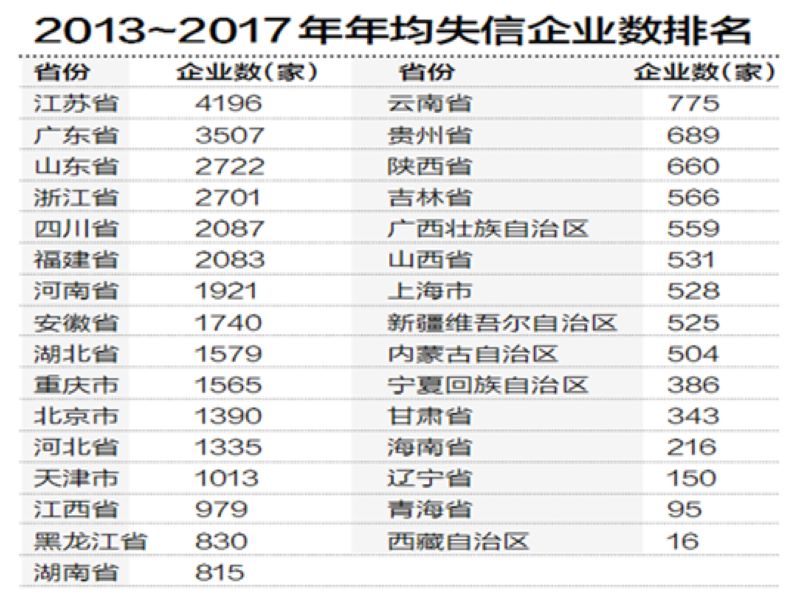
The analysis results of above data show that the more developed the region is, the more the annual average newly-increased dishonest enterprises are, indicating that the dishonesty of enterprises is a periodic feature in the process of economic development. As China is in the period of economic transformation, there is a high degree of uncertainty in the market, which will lead to various kinds of dishonest behaviors of enterprises in the rising period to a great extent.
In 2007, the amendment of the Civil Procedure Law of the People’s Republic of China established the system of the list of dishonest persons subject to enforcement. On July 16, 2013, the Supreme People’s Court issued Several Provisions on Publishing the List Information of Dishonest Persons Subject to Enforcement, and opened the platform of “disclosure and inquiry of the list information of dishonest persons subject to enforcement of the national court” on October 8, 2013, which disclosed the prelude of social announcement of the list of dishonest persons subject to enforcement. On November 14, 2013, the Executive Department of the Supreme People’s Court signed a memorandum of cooperation with the Credit Registration Center of the People’s Bank of China, which included the dishonest behaviors judged by the court into the credit history.
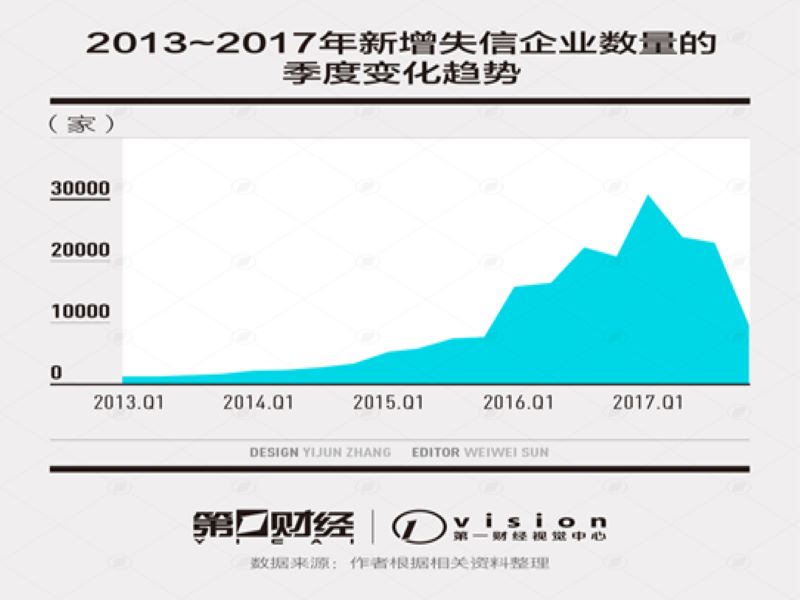
According to the Provisions on Publishing the Information of Dishonest Behavior in the Execution of Court Judgment, there are six types of dishonesty in the execution of court judgement: those that have the ability to perform but refuse to perform the obligations determined by the valid legal documents; those that obstruct or resist to execute by means of forging evidence, violence or threat; those that evade to execute by means of false litigation, false arbitration or concealment or transfer of property; those that violate the property report system; those that violate the consumption restriction order; those that refuse to implement the settlement agreement without justified reasons. Pursuant to the dishonest enterprises information published by the platform of “disclosure and inquiry of the list information of dishonest persons subject to enforcement of the national court”, the number of newly-increased dishonest enterprises in China has experienced two stages of “sharp increase and sharp decrease” form 2013 to 2017. From the first quarter of 2013 to the fourth quarter of 2016, the number of newly-increased dishonest enterprises increased quarter by quarter, with an average quarterly growth rate of 24.98% (as shown in the following figure).
How to reduce the dishonest behavior of enterprises?
Although there is more number of newly-increased dishonest enterprises in the regions with high degree of marketization, the rate of newly-increased dishonest enterprises is lower than that of undeveloped areas. In terms of quantity, the growth number of enterprises default in developed areas is faster than that in undeveloped areas, but in terms of the proportion of newly-increased enterprises default, the default rate in developed areas is far less than that in undeveloped areas. This is mainly because the perfect market environment and market system play the role of resource allocation of the invisible hand of the market. The subjective willingness of enterprise default is reduced by rewarding the trustworthy enterprises and punishing the default enterprises.
How to reduce the dishonest behaviors of enterprises? Both invisible hand of the market and the visible hand of the government should play a role.
Improving the credit restraint mechanism is the key measure to reduce the dishonest behavior of enterprises. For the outstanding lack of credibility, we should not only promptly create a credit reference system covering the whole society, but also improve a law-abiding credit commendation mechanism and a law-violating dishonesty punishment mechanism, so that people dare not and cannot lose their credit. Meanwhile, it is necessary to further explore the regional joint punishment system for dishonesty, for example, the experimental system can be explored in “three provinces and one city” in the Yangtze River Delta, which will be extended to the whole country after reaching achievements.
Breaking the information isolated island and strengthening the joint enforcement can reduce the number of intentional enterprises default. Due to the existence of information isolated island, the default information of enterprises is not fully interconnected among regions, and the enterprises can exempt from the “dishonesty punishment” by regions transfer; information between departments is not fully shared, for example, tax, industry and commerce, public security and credit information is not fully shared, and the default in a department can not be extended to other departments, which makes the “dishonesty punishment” insufficient. It has a great significance to establish an online shared enterprise credit interconnection platform for reduce the enterprises default.
 TEL:021-65908960
 ADDR:上海市杨浦区武川路111号(200433)