

Promote Financial and Tax Policy Integration of the Yangtze River Delta
The core ofintegrated financial and tax policy of the Yangtze River Delta region is mainlymanifested in two aspects: firstly, form financial and tax system favorable forthe total factor flow of the Yangtze River Delta region; secondly, establishnew financial and tax systems in the Yangtze River Delta region based on mutualbenefit.
President Xi Jinpingmentioned in his keynote speech at the opening ceremony of the first ChinaInternational Import Expo on November 5th, 2018 that the integrated developmentof the Yangtze River Delta region will be supported and raised to a nationalstrategy. In the government work report of 2019 made by Premier Li Keqiangpointed out that the integrated development of the Yangtze River Delta region willbe raised to a national strategy and the development planning outline will becompiled and implemented. The Central Party Committee raises the integrateddevelopment of the Yangtze River Delta to a national strategy means that theintegration of the Yangtze River Delta not only needs to reflect thecomprehensive efficiency of the regional social economy, but also becomes theengine for the coordinated development of regional economy of our country.
From the perspectiveof result orientation, the integration of the Yangtze River Delta region willfinally form the high quality coordinated development in various aspects of thesocial economy of the three provinces and one city in the region, including thecoordinated development of industry structure, interconnection andinter-communication of traffic network, sharing mechanism of medical resources,and joint governing and management of environmental protection, etc. The routefor achieving such an objective should be dominated by the market mechanism andassisted by government coordination, to form the pattern of rational flow oftotal factors in the Yangtze River Delta region. Therefore, it is indispensibleto formulate financial and tax policies of the Yangtze River Delta.
The core ofintegrated financial and tax policy of the Yangtze River Delta is mainlymanifested in two aspects: firstly, form financial and tax system favorable forthe total factor flow of the Yangtze River Delta region; secondly, establishnew financial and tax systems in the Yangtze River Delta region based on mutualbenefit.
Production factorflow oriented motivations include the drive of the market interest and thedifference of public service level. The interest-prone flow of factors ismainly determined by the market and is allocated as per the principle of marketcompetition. What deserves attention is that the orientation of the factor flowin a relatively mature market economy system pays more attention to the publicservice whose supply mainly depends on the allocation of government financialresources.
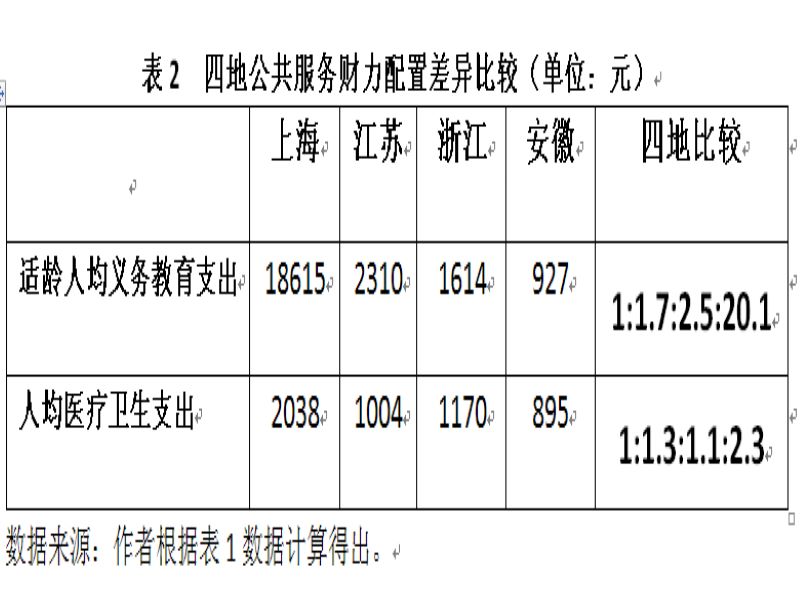
As for the status quoof the main public service resources of the Yangtze River Delta (as shown inTable 1) and financial allocation level (as shown in Table 2), there arerelatively big differences, which is obviously unfavorable for the rationalflow of the labor and financial factors.
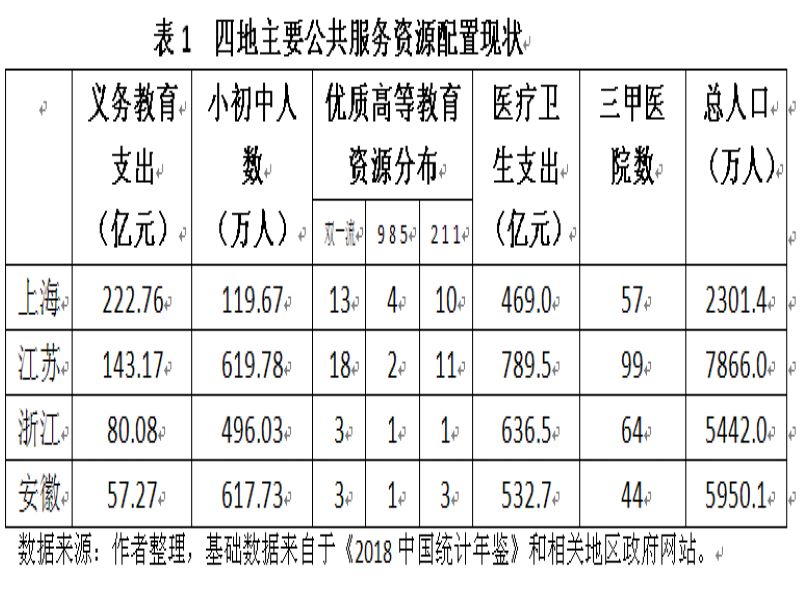
Take the allocationstatus quo of higher education and high quality medical resources as anexample. Double first class universities of Jiangsu are 6 times of Jiangsu andAnhui, tertiary hospitals of Jiangsu are nearly 2.5 times of Anhui; if the percapital level is considered, the difference may be even bigger. As for the percapita financial expenditure level of school age of compulsory education, Shanghaiis 2.5 times of Zhejiang and 20.1 times of Anhui; as for the per capitafinancial expenditure level of medical treatment and health, Shanghai is 2times of Jiangsu and 2.3 times of Anhui.
Therefore, it isclear that the equalization differences of public services in the Yangtze RiverDelta region are relatively big, unfavorable for the rational flow of theinter-region total factor flow. Therefore, the common development of the regioncan only be achieved through the regional coordination of financial and taxpolicy, by rationally adjusting and optimizing the structure of basic regionalpublic service and promoting the free flow of production factors in anall-round way.
The implementation ofthe integration planning of the Yangtze River Delta needs the comprehensivecooperation and coordination of the governments of the three provinces and onecity, and it is obvious that the cost sharing of the public service and theinterest allocation of the government finance are the key. Though the nationaltax and financial policy is uniform and the government budget expenditure alsohas basic standard, the execution and management policies of each regionusually start from their own interest and objectively there is such a tendencyof inter-government malicious competition by using the financial and taxtools.
By comparing thegovernment reports of 26 cities in the Yangtze River Delta region, it isdiscovered that the difference of the actions taken by each region toparticipate in the integration of the Yangtze River Delta reflects thischaracteristic more or less. Therefore, only under the precondition ofcoordination and consensus of the financial and tax management system of theYangtze River Delta region, the win-win objective can be achieved by breakingthe inter-government special financial and tax management and control andestablishing inter-government cost sharing and tax and fee interest sharingmechanism.
To achieve the overall requirements of integration of theYangtze River Delta and various planning objectives, it is an important “work” of thestrategic deployment of the Party Central Committee with high quality toestablish regional financial and tax policy system and the planning andcoordination mechanism of financial and tax system. Therefore, the followingthree recommendations are put forward:
Firstly, establish“financial and tax policy commission for the three provinces and one city ofthe Yangtze River Delta region” and establish four-region provincial jointconference mechanism with the mission as coordinating regional financial andtax policy and unifying management mechanism. Take the financial and tax policyas the central task, coordinate relevant culture, education and culture, aswell as cross-region infrastructure, talent flow, household registrationsystem, investment and financing policy, etc.
Secondly, establishkey financial and tax policy coordination mechanism. First, it needs toestablish the coordination mechanism of tax preference policy within theregion, with the mission as breaking through the factor flow obstacles, treatingthe factor flow fairly, and encouraging the optimal allocation of factors;second, it needs to standardize the financial subsidy policy in the region,with its mission as achieving the regional public service equalization in theregion, optimizing the regional industry structure layout, and improving theoverall business environment of the region.
Thirdly, adjustregional financial system. Under the precondition of not changing the financialsystem of “system of tax distribution”, establish the transverse transfer payment system of the Yangtze River Delta region, with itsmission as making up the short board of inter-regional public service,correcting the externality spillover effect deviation of inter-region publicprojects, and dealing with the inter-region cost compensation and interestallocation, etc.
 TEL:021-65908960
 ADDR:上海市杨浦区武川路111号(200433)