

On Epidemic Prevention and Control in Wuhan-Chinese Perspective
At the early stage of the epidemic outbreak, local epidemic information was mainly reported level by level within the administrative system, which might lose the optimal time for governing the crisis to some extent. It is necessary to establish a dual supervision system of public health which takes information technology as the carrier to provide a good system guarantee for the epidemic prevention and control.
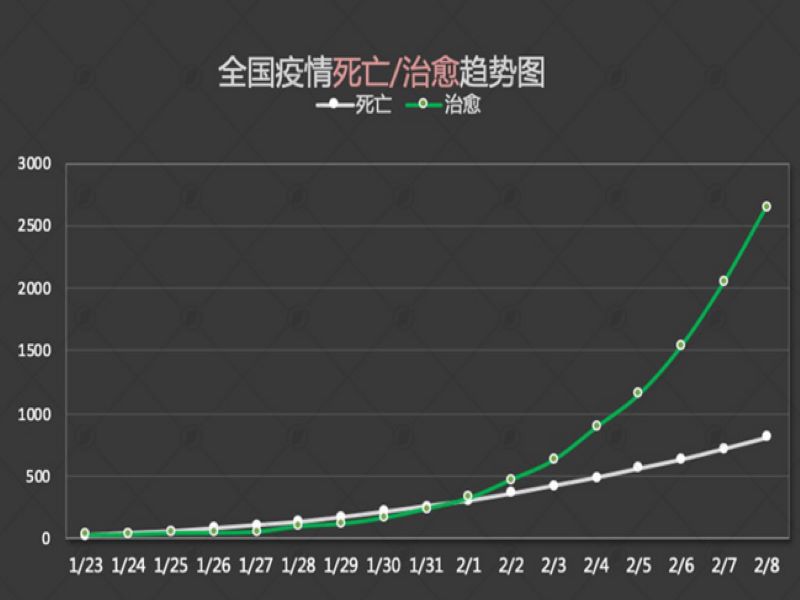
During the Chinese spring festival, a large population returned to their hometown for the spring festival, plus that families gathered together for meals, etc, the COVID-19 spread quickly in the country. Government of different levels advocated home quarantine, extension of spring festival holiday, etc. By 9:00 clock, February 9th, there were totally 37251 confirmed cases, with 812 death cases and 2651 cured cases.
The epidemic spreading as well as the prevention and control work exposes some problems of the governing capability of local governments, such as timely exposure of epidemic information, the inter-region and inter-department coordination of epidemic work, etc. Summarizing the catching up cases of big powers in the human development history, we always discover that the national capacities, especially governance capabilities, play an extremely role in it. What is the space spreading law of this epidemic? How should we improve the local governance capability to prevent and control the epidemic effectively?
Development trend of the COVID-19
The relatively early information about the COVID-19 was the “Report on the pneumonia epidemic of Wuhan by Wuhan Health Commission” on December 31st, 2019, which mentioned that currently 27 cases have been discovered, with 7 severe cases, other cases stable and controllable, 2 cases getting better and to be discharged soon; by far, there has been no inter-person infection as per investigation, and no medical staff infection has been discovered. The information provided by this report shows that, at that time, Wuhan Health Commission didn’t realize the particularity and seriousness of this pneumonia epidemic.
On January 7th, 2020, the pathogen of “viral pneumonia of unknown origin” in Wuhan was initially judged as novel coronavirus. On January 11th, the announcement information at the website of Wuhan Health Commission mentioned that there were 41 COVID-19 cases through initial diagnosis, including 2 discharged cases, 7 severe cases and 1 death case, and all other patients were in a stable condition. In the following more than half a month, the confirmed and suspected cases of COVID-19 rose day by day; especially from the 2nd of Chinese Lunar New Year (January 26th), the increase of newly confirmed and suspected cases showed a small peak.
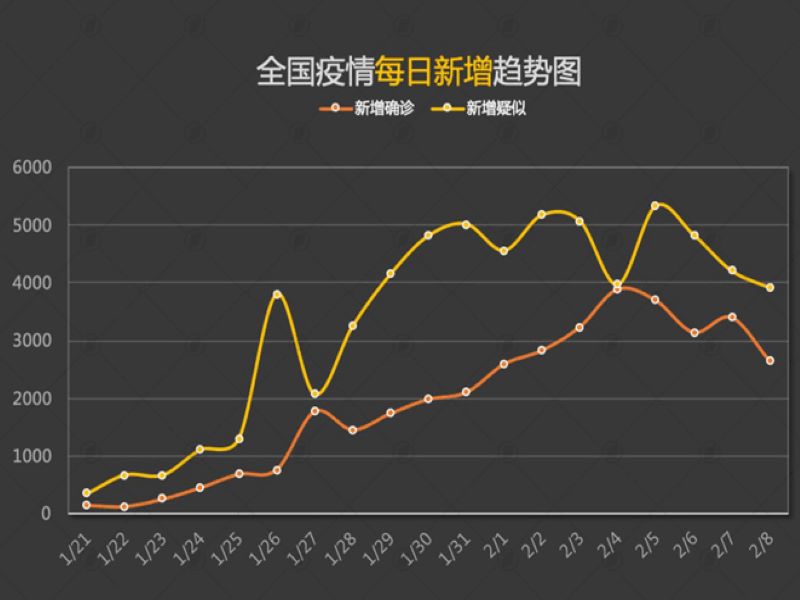
As for the national epidemic distribution condition, Hubei Province is the hardest hit region of the epidemic, with the confirmed cases accounting for 64% of the state; regions adjacent with Hubei geographically or having tight economic connection with Hubei also became the high occurrence region, such as Guangdong, Hunan, and Henan. As per information provided by Baidu Huiyan, on January 20th, 2020, about 6% of the emigration population from Wuhan flew into Henan Province, 3.17% flew into Hunan, 1.84% flew into Jiangxi, and 1.27% flew into Chongqing.
The reasons why the epidemic presented a rising trend are as the following: firstly, at the early stage of the epidemic outbreak, the conditions for virus testing were restricted, which caused that many cases unable to be confirmed. On January 16th, Hubei Disease Prevention and Control Center received the virus nucleic acid testing kit released by the state, and started to have pathogen testing for the viral pneumonia patients’ specimen received. Before it, the virus specimen needed to be sent to the Chinese Center for Disease Control and Prevention for verification and testing. With the increase of the testing kits received by different places, the problem that the cases which were unable to be confirmed or confirmed slowly was solved, and the confirmed cases increased gradually. Secondly, more and more people returned to their hometown during the spring festival holiday, which increased the group gathering, plus that the virus has a 14-day incubation period, therefore, there were not too many cases were confirmed at the early stage.
Population flow and the epidemic spreading in Wuhan
From the 1990s to the beginning of this century, with the development and increasing needs for labors of the coastal cities, the transient population of China increased sharply. By 2000, the total transient population exceeded 0.1 billion. Since then, a series of policy documents released and favorable for the population migration and flow has further promoted the continuous expansion of transient population. From 1990 to present, the transient population mainly migrates within the province, but with the ratio dropped a little. The ratio of cross-province migration has increased fast since 1990 and reached a peak in 2005 before falling back. As per the information provided by statistical bulletin of national economic and social development of Hubei Province in 2018, by the end of 2018, there was a permanent residential population of 59.17 million, including an urban and town population of 35.6795 million and a rural population of 23.4905 million, with the urbanization rate reaching 60.3%.
To improve the income level, a large number of rural residents in Hubei Province flow into cities, especially big cities like Wuhan. As per the information provided by Baidu Huiyan, by taking January 10th and January 20th, 2020 as an example, we had statistics for the destination information of the population emigrating from Wuhan about 62% and 71% of the population emigrating from Wuhan has their destination as other cities of Hubei Province respectively. The population flow plays a striking promotion role in regional economy increase and economic coordinated development as well as the disease spreading.
In recent years, the increasing urbanization process makes a large population gathering in big cities and megacities, and potential diseases may break out any time with the population increase and population migration to the big cities. Meanwhile, the construction of urban public health system is still hard to meet the population of such a large scale; therefore, the potential supply and demand imbalance of public health products appears. The COVID-19 spreading with Wuhan as the epidemic focus also reflects the above problem.
To verify above views, we utilized national survey data of health and family planning dynamic monitoring of 2017, calculated the ratio of transient population in Wuhan from various prefecture-level cities of Hubei, with the details as the following: transient population ratio of City A=the number of Wuhan transient population with the household registration in City A / total transient population in Wuhan. The transient population in Wuhan usually returns to their hometown for the Chinese Lunar New Year. If such a group is infected with the virus, the disease may be spread to the place of domicile upon the hometown returning. We think this is an epidemic spreading risk brought up by transient population.
We further had statistics for the confirmed cases of COVID-19 from January 1st to February 6th, 2020 of various prefecture-level cities in Hubei, most of the cities began to report confirmed cases on January 22nd. What we care for is the influence of the transient population on the epidemic spreading with the transient population returning their place of domicile in the spring festival holiday. Therefore, we designed two key indicators: 1. confirmed cases of the city, we adopted the ratio of the confirmed cases of each city in the total confirmed cases of Hubei Province to reflect the relative seriousness of the epidemic of the city; 2. Urban transient population, we adopted the ratio of the urban population flow mentioned above.
We further adopted statistics method to estimate the influence of urban transient population on the epidemic spreading. Here, several key factors need to be considered: 1. the increase of testing kit production. We solve it by controlling the time effect of each day. 2. The difference of urban public health system construction. We solve it by controlling the characteristics of each city. 3. Policy issued by the city every day. We solve it by controlling the multiplicative item of each city and time. After the above factors are controlled, we estimated the dynamic change of influence of the population flow on the epidemic spreading with the time change. The research result displays that during January 1st to February 6th, the higher the transient population of each prefecture-level city has, the more confirmed COVID-19 cases there are in the region; and the influence gets striking starting from January 27th and gets stronger day by day. However, with the publicity getting more and more on the media, will human’s focus on such information increase? If there is obvious increase, then human’s prevention awareness will be enhanced too.
Considering the importance of this problem, we further estimate the influence of the transient population on the focus of COVID-19. We collected each urban citizen’s search index for the key word “COVID-19” through Baidu Index. The higher the index shows that the mass has higher focus on such a problem. Considering the urban difference, we further used the mass’ search index for the key word “novel coronavirus” in Hubei Province as the weight, designed the focus indicator of “novel coronavirus” = urban “novel coronavirus” search index / Hubei provincial “novel coronavirus” search index. The search result shows that from January 1st to February 6th, the ratio of the transient population of each prefecture-level city had no significant influence on the focus indicator of “novel coronavirus”, which proves from one aspect that the virus constantly spreads because human fails to attach great importance to the virus in mentality. Recently, on the Internet, we could also observe that the government of different levels has rung the alarm of mentality for the mass, which is very important for the preventing the virus spreading.
Traffic network and the epidemic spreading in Wuhan
China’s fast-speed railway project started in 2003. In 2004, Middle and Long Term Development Planning of Chinese Railway was passed and was adjusted in 2008. The development momentum of fast speed railway speeds up. As per Middle and Long Term Development Planning of Chinese Railway, Chinese government establishes fast passenger transportation channels among provincial cities as well as middle and big cities by planning “four vertical and four horizontal” passenger dedicated lines and inter-city passenger transportation system in economically developed regions. Currently, the four vertical and four horizontal framework of “China’s fast speed railway” has been formed basically. To better serve and support major national strategy, in July, 2016, the National Development and Reform Commission, the Ministry of Transport of the People’s Republic of China, and China State Railway Group Co., Ltd. jointly issued Middle and Long Term Railway Network Planning (2016 to 2030), painted a grand blueprint of “eight vertical and eight horizontal” fast speed railway network. By the end of 2015, China’s high speed railway has had an operation mileage of 19,000 kilometers. As per middle and long term development planning of railway, by 2020, the national fast speed railway will be up to 30,000 kilometers.
The advantage for opening the fast speed railway lies in that it has shortened the time distance between cities, helped human to migrate between cities more conveniently. Population flow is a visible fact, and fast speed railway can reflect the connection degree between cities, or inter-personal connection closeness between cities. Why do we consider such a factor? The reason is that virus may be not just spread by transient population working in a certain place, but also by non-transient population coming and going between two places. Through 12306 website, we inquired fast speed trains connecting various cities of Hubei with Wuhuan, and estimated the dynamic change of the influence of high speed trains on epidemic spreading with time. The research result shows that from January 1st to January 31st, the more train connections each prefecture-level city had with Wuhan, the more confirmed COVDI-19 cases there was in the city. What is more important is that the above distinctive correlation also occurred from January 25th to January 28th, that is 2 to 5 days after the shutdown of Wuhan in January 23rd. The above result also proves the influence of transient population on the epidemic spreading from another aspect, and the group exchange between the epidemic center and non epidemic center carried out in various forms may cause the epidemic spreading.
National governance capability and epidemic prevention and control in Wuhan
Promoting the modernization of national governance system and governance capability put forward at the Fourth Plenary Session of the 19th CPC Central Committee is of important guiding significance for the prevention and control of this epidemic.
Firstly, information technology plays a more and more important role in the national capacity construction, and government of different level actively introduces new technology and means, and applies them into grass-root governance, to finally reach the objective of good governance. At the early stage of the epidemic outbreak, local epidemic information was mainly reported level by level within the administrative system, which might lose the optimal time for governing the crisis to some extent. It is necessary to establish a dual supervision system of public health which takes information technology as the carrier to provide a good system guarantee for the epidemic prevention and control. Epidemic prevention and control seriousness depends on the supervision system quality, information smoothness is a necessary condition for successful improvement of supervision system efficiency. The central government and local government should coordinate, thoroughly use the advantage of information technology and big data, and establishes direct information communication platform from the grass-root level to the central government. It is critically important for the early stage epidemic prevention and control to utilize current the vertical supervision in the administrative system and the direct supervision with new technology as the carrier which are two supplementary supervision systems to enhance the availability of authentic information.
Secondly, in emergency public health event, it is far insufficient to rely on the fighting of just medical units of one province or even one city, and it is a must to have cross-province and cross-department cooperation to control the epidemic. This epidemic just exposes the cooperation insufficiency between departments. Therefore, it is necessary to establish public health supervision organizations affiliated to the central government directly, coordinate the cross-region and cross-department forces, and improve the handling capability for emergency public health event.
Thirdly, the difficulty in the epidemic prevention and control in the wide rural areas far exceeds the urban area, and it is necessary to enhance the core role of grass-root Party organization in epidemic prevention and control. In the prevention and control work of the COVID-19, it is suggested taking the village (community) as the focus, giving play to the core leadership role of the grass-root Party organization, enhance the publicity work of the epidemic prevention and control, and combining the grass-root governance and epidemic prevention and control organically.
Finally, enhance to educate the mass on the knowledge of public health and epidemic prevention and control. The emergency public health crisis represented by the COVID-19 originates from the lack of public health knowledge to some extent, such as not eating wild animals, personal protection measures during the epidemic, etc. Give full play to the important role of grass-root governance organizations, such as neighborhood committee, etc., and popularize the public health and epidemic prevention knowledge to the mass periodically.
 TEL:021-65908960
 ADDR:上海市杨浦区武川路111号(200433)