

Professor Li Shi from Zhejiang University Participated in “PhoenixFamous Expert Forum” As A Guest to Interpret China’s Income Allocation System Reform and Common Prosperity
In the afternoon of December 18, 2023, Professor Li Shi, Senior Professor of Liberal Arts of Zhejiang University and Director of Zhejiang University Institute of Sharing and Development, participated in “Phoenix Famous Expert Forum” as a guest and made a lecture titled “China’s Income Allocation System Reform and Common Prosperity”, which attracted nearly one hundred teachers and students from the China Institute of Public Finance, the School of Public Economics and Management and other brother schools to attend.
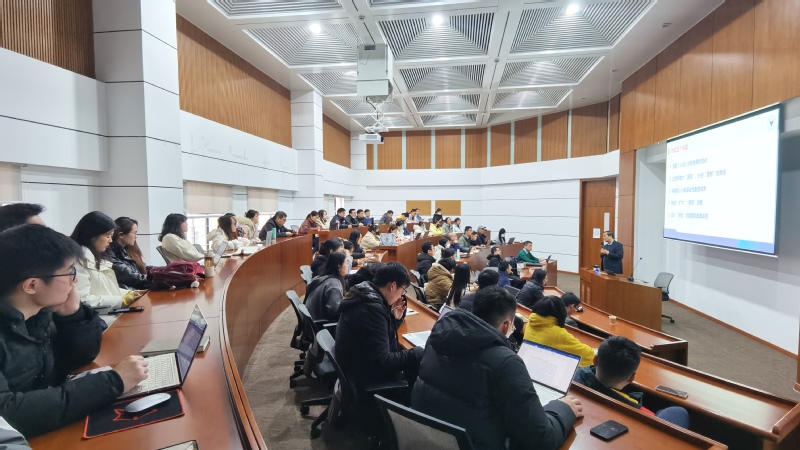
Professor Li Shi made comprehensive and in-depth analysis of the issues related to income allocation and common prosperity from five aspects, namely the change of personal income allocation situation in China, the well handling of the relation between “Making Cake” and “Dividing Cake”, the establishment of fundamental system of income allocation, the formulation of the strategy of “Expanding Middle Class” and “Lifting the Low-income Class”, and the design of the system and policy system for “Lifting the Low-income Class”.
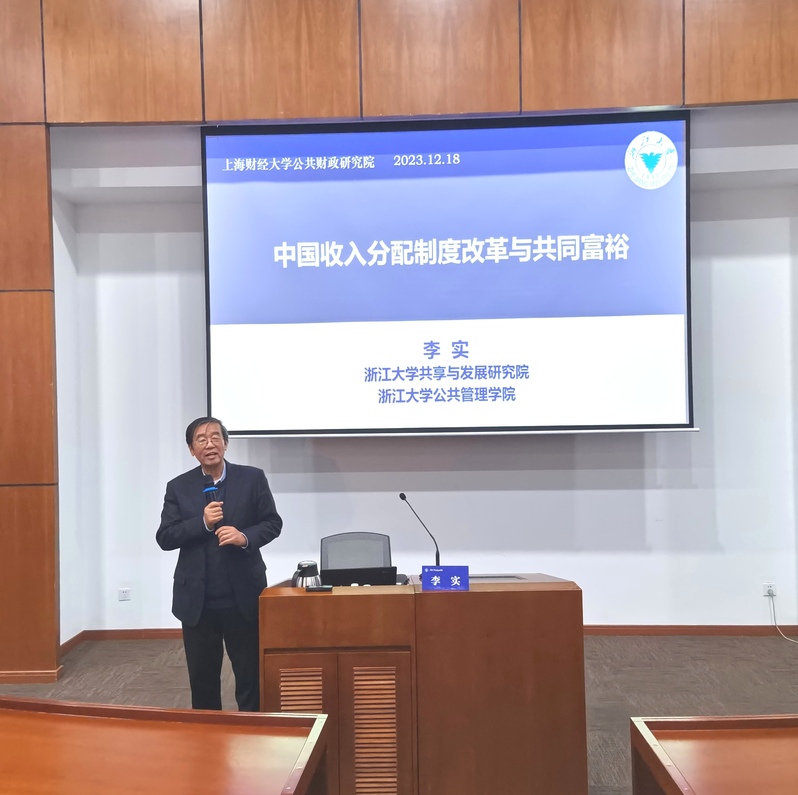
Firstly, regarding the basic situation and changing process of China’s income allocation, Professor Li Shi believed that it can generally be divided into two stages with the year 2008 as the breakpoint. Before 2008, the income gap in China had comprehensively widened, including the income gap within cities, the income gap within rural areas, the income gap between industries, and the income gap between occupations, they all continuously widened. After 2008, the situation of income gap somewhat changed, the income gap within rural areas and the income gap within cities still widened to certain extent, but the income gap on national level has been slowly narrowed for a few years. In recent five or six years, it’s basically in the state of high-level fluctuation, it neither declined nor increased.
Secondly, regarding the issue of relation between “Making Cake” and “Dividing Cake”, Professor Li Shi believed that it’s necessary to set long-term economic growth goals, and recommend the reform policies that benefit the enhancement of economic growth rate, such as promoting the reform of the household registration system, the reform of rural land system, and the construction of rule of law society, and truly return to the track of development centered in economic construction, which is the key of “Making Cake”. Regarding the issue of “Dividing Cake”, Professor Li Shi proposed that extensively reducing the Gini Coefficient is a nearly impossible goal, it’s unnecessary for policies to aim at Gini Coefficient or other similar indicators, but to focus on enhancing the ratio of middle-income population. He proposed the standard of middle-income population in China, which is about the level of annual household income at ¥100-500 thousand. According to this standard, the proportion of middle-income population in China in 2018 was about 30%, there’s still a lot of room to improve.
Thirdly, regarding the establishment of fundamental system of income allocation, Professor Li Shi proposed that the primary allocation need to enhance the market level of elements; the secondary allocation need to enhance the ratio of direct income, especially to enlarge the tax coverage of high-income population; and the tertiary allocation needs to enhance the development level of social organizations and charities undertaking.
Lastly, regarding the relation between “Expanding Middle Class” and “Lifting Low-income Class”, Professor Li Shi believed that compared to “Expanding Middle Class”, “Lifting Low-income Class” is more important and easier to realize. “Lifting Low-income Class” can be implemented from three aspects, namely empowerment, equal rights and good deeds. Empowerment means enhancing the development ability of low-income population, cutting off the generational passage of poverty; equal rights means to demolish unreasonable system barriers, giving the low-income population the fair and reasonable opportunities of development; good deeds means to target the low-income population with incapability of work, to guarantee their basic and decent life.
At the last of lecture, the attending teachers and students developed discussion on the issues such as enhancing the endowment insurance benefits of rural residents, encouraging rich people to do charity, helping aged migrant workers in employment, and the influence of household registration system on salary, etc. Due to the limitation of time, after the lecture ended, many teachers and students had not given full expression to their views, and looked forward to developing more exchanges and cooperation with Professor Li Shi in the field of income allocation.
 TEL:021-65908960
 ADDR:上海市杨浦区武川路111号(200433)