

The 1st Finance and Taxation Policy Saloon Successfully Held to Interpret Finance and Taxation Reform in the Central Economic Work Conference
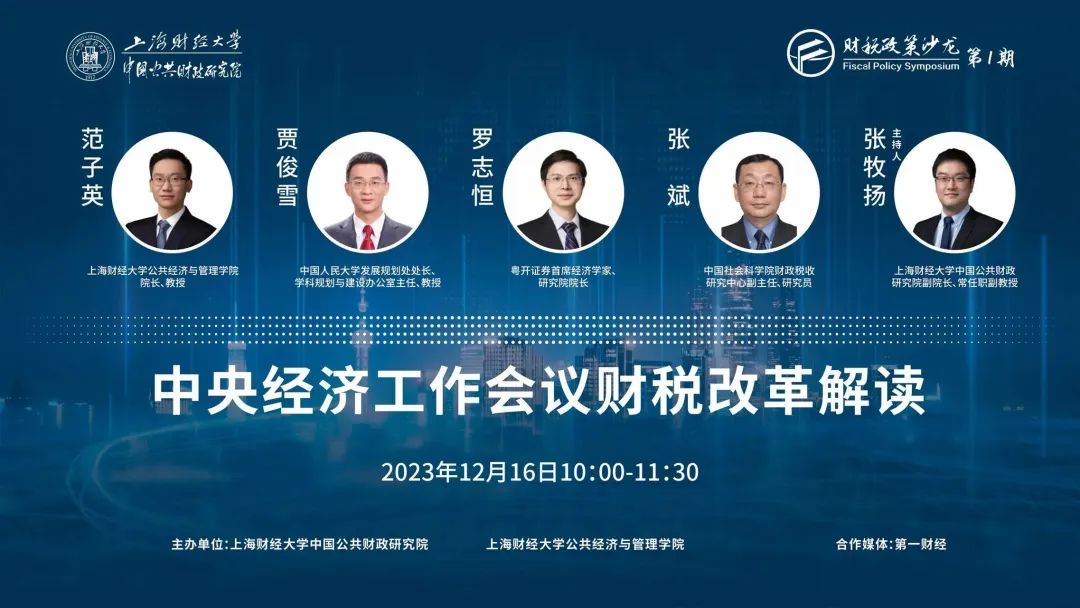
On December 16, 2023, the 1st Finance and Taxation Policy Saloon jointly organized by the China Institute of Public Finance, Shanghai University of Finance and Economics and the School of Public Economics and Management, Shanghai University of Finance and Economics was successfully held and made synchronous live streaming on the CBN Web-end Broadcasting Channel. Experts and scholars in the digital finance and taxation field made analysis and discussion over the finance and taxation policies at the Central Economic Work Conference, as well as envisaged the finance and taxation policies in the future.
This Saloon was presided over by Regular Associate Professor Zhang Muyang, Deputy Director of the China Institute of Public Finance, Shanghai University of Finance and Economics, and it was divided into two processes, namely expert keynote speeches and exchange & interaction.
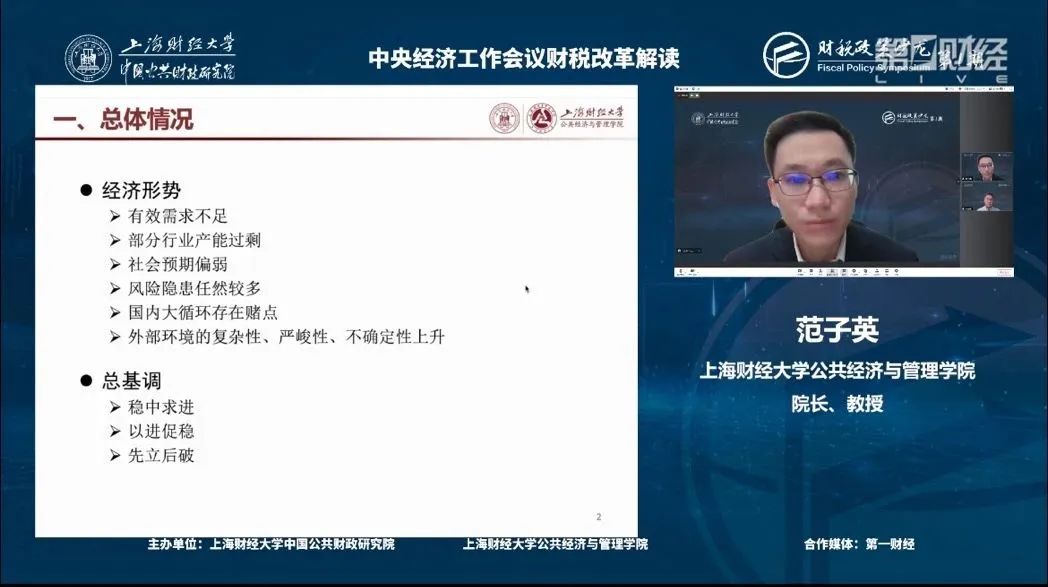
The first expert who made speech was Professor Fan Ziying, Director of the School of Public Economics and Management, Shanghai University of Finance and Economics. Fan Ziying firstly reviewed the judgement of economic situation at the Central Economic Work Conference, and indicated that the current Chinese economy mainly faces six major challenges, including insufficient effective demands, overcapacity in some industries, relatively weak social expectations, relatively many risks and potential hazards, existence of obstacles in domestic circulation, and the rising complexity, severity and uncertainty of external situation. It was found out through the sorting and comparison between the texts of finance and taxation policy in the Central Economic Work Conference of last year and this year that in the aspects of overall fiscal policy direction, fiscal expenditure, government debt, tax reduction and transfer payment, the Central Economic Work Conference of this year all had new and different proposals, especially that it proposed to plan for new round of finance and taxation system reform. Lastly, Fan Ziying envisaged the finance and taxation policies in next year and later period from the aspects of tax reduction, risk of debts, and finance and taxation system reform, etc.
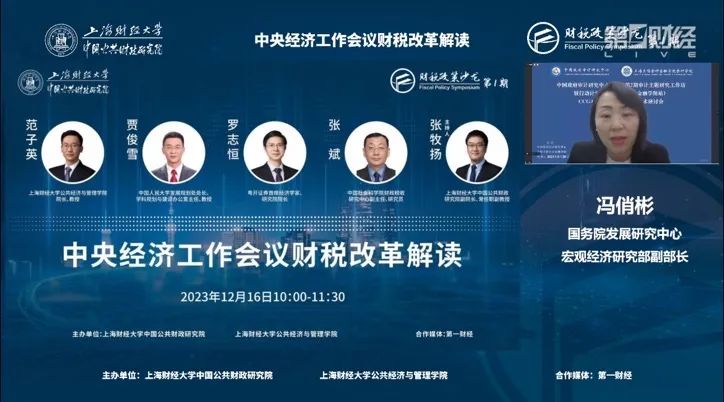
Ms.Feng Qiaobin, Deputy Chief of the Macroeconomic Research Department of the Development Research Center of the State Council made a speech titled “New Round of Finance and Taxation System Reform Shall be Problem-oriented”, the key of which was to propose her own views over the part of “Planning new round of finance and taxation system reform” in the Central Economic Conference. Feng Qiaobin indicated that the fiscal field of China has the main issues including unsustainable scale of transfer payment from the Central Government, fiscal difficulty in local government, and several debt situation in local governments, etc., the finance and taxation system reform shall be problem-oriented, and consider the new background in the process of Chinese economic transformation, and make planning in forward-looking vision. In the practical operation, it’s necessary to strengthen survey and research, continue to promote the practice of not only having reforms, correctly handling the fiscal relationship between Central Government and Local Governments, considering the mobilization of local governments to venture in real business and develop the initiatives of economic development as the core content, and considering aiming at the construction of unified national market as a basic direction, but also considering the various complex and realistic issues in current fiscal operation, so as to promote the two aspects collectively.
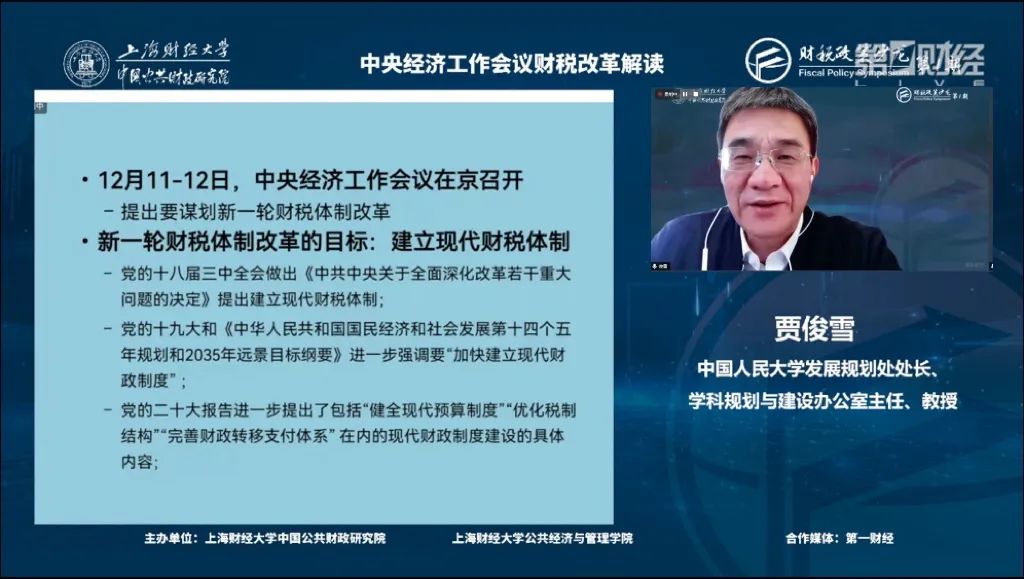
Professor Jia Junxue, Director of the Development Planning Department and Director of the Discipline Planning and Construction Office of the Renmin University of China was the third to make speech. Jia Junxue believed that the new round of finance and taxation system reform shall explicitly consider the establishment of a modern finance and taxation system as the goal, use the new round of finance and taxation system reform to promote the establishment of modern finance and taxation system. The core of modern finance and taxation system construction is to establish an optimized and sustainable model of divided fiscal power, and shall follow the principles of benefiting the modernization of national governance, enhancement of market resources allocation efficiency with balancing of social equality, and fully mobilizing the initiatives of both the Central Government and local governments. In the aspect of overall thoughts of reform, he primarily focused on the following four aspects: the first is to establish a system with adaptability between powers and expenditure responsibility, the second is to establish an incentive-integrated income allocation system, the third is to establish a transfer payment system that benefits balanced development among regions, and the fourth is to improve the provincial fiscal system.
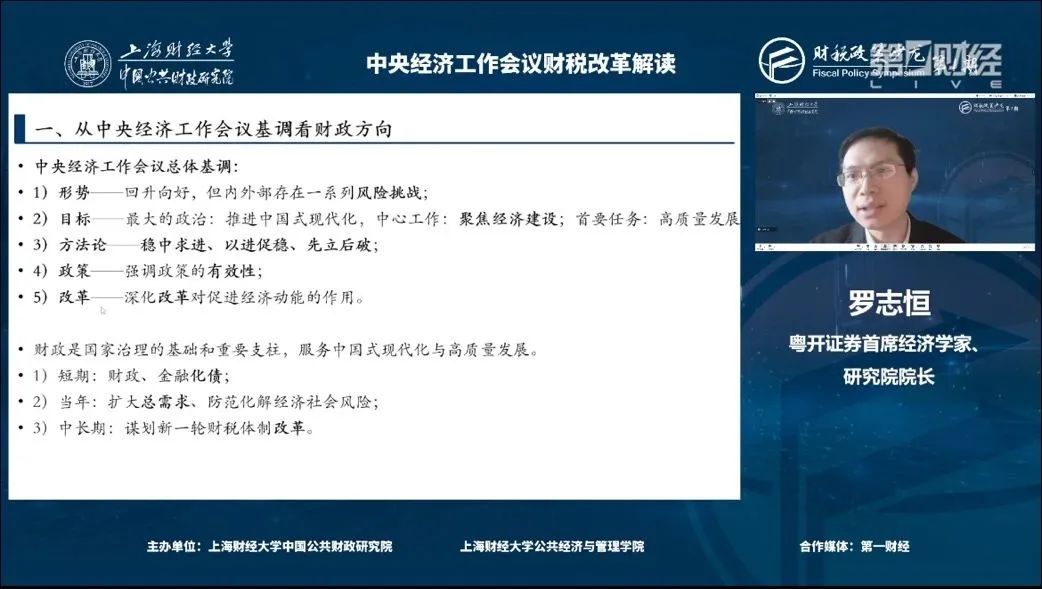
Mr. Luo Zhiheng, Chief Economist of Yuekai Securities and Research Institute, made a speech at last. Luo Zihheng believed that the direction of fiscal work is ultimately to serve the grand theme of Chinese-style modernization and high-quality development. The overall trend of Chinese economy in this year is recovery and improvement, but we still face a series of risks and challenges both internally and externally, therefore we need to implement a proactive fiscal policy that is properly energized with quality enhancement and efficiency increase. The main task facing fiscal policy is to reduce debts and expand aggregate demand in short term, and plan new round of finance and taxation system reform in midterm and long term. Through comparison and analysis of the effectiveness of different fiscal policies, Luo Zhiheng stressed to strengthen the coordination between non-fiscal policies and fiscal policies, and the coordination between non-economic policies and economic policies, strengthen the systematic integration between different methods of fiscal policy, and strengthen the efficiency and effectiveness of policies, and promote fiscal policies to transform from “Quantity and Scale Model” to “Efficiency and Effectiveness Model”.
Surrounding the speeches by the four guests, the host proposed two interactive questions: the first was that from long-term perspective, how the finance and taxation system reform in the future should handle the balance between the two policy objectives of regional balance and initiative of local governments; the second was that in short term, in which specific aspects the reform could start to launch.
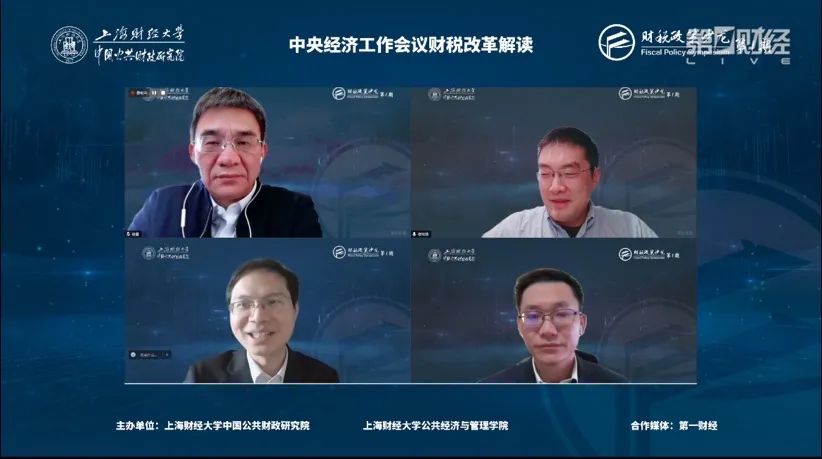
Professor Jia Junxue believed that only high-level and high-quality regional balance is the objective we pursue, while fully mobilizing the initiative of local governments is an important precondition to realize this objective. Only by fully mobilizing the initiative of local governments, we can effectively promote economic development, so as to realize high-level regional balance. In short term, we need to further activate market vitality , stimulate confidence among enterprises, define the relationship between government and market, and solve a series issues of fiscal revenue pressure brought by economic downturn. Director Luo Zhiheng shared his view from the perspective of relationship between equality and efficiency. Local economic development is a matter of efficiency, while regional balance is a matter of equality. Besides, it’s necessary to emphasize on transformation of government functions, only then we can better implement finance and taxation system reform. Professor Fan Ziying believed that it might be impossible to realize the rebalance between regional balance and initiative of local government under the current fiscal transfer payment system, one thought of reform is to increase the tax sources in inland regions and reduce transfer payment. The most important thing at current stage is to enable the economy to return to a relatively normal and healthy trajectory of growth, we may consider starting from the aspects like special debt reform and promoting the finance and taxation reform.
The experts and scholars attending the saloon made professional interpretation and heated discussion over the finance and taxation policies in the Central Economic Work Conference, the 1st Finance and Taxation Policy Saloon closed successfully. This activity was also the first specific practice after the Fiscal and National Governance” Huang Danian-style Teacher & Student Party Branch and the 4th Party Branch of CBN signed the united construction and joint construction agreement. In the future, the two parties will also explore the joint construction model of integrating party construction with business operation, so as to have in-depth promotion of the “One Integration and Two High” of party construction work and business development.
 TEL:021-65908960
 ADDR:上海市杨浦区武川路111号(200433)